
Freeloading
Economics should trump what is actually best for people with MS; i.e. neurologists should prescribe rituximab over the more expensive innovator drugs as it saves their healthcare system money.

I have received quite a few emails from international colleagues in response to yesterday’s Q&A about which anti-CD20 is best for treating MS. The overall gist of the emails is that economics should trump what is actually best for people with MS; i.e. neurologists should prescribe rituximab over the more expensive innovator drugs as it saves their healthcare system money.
Dare I disagree with them? When Norway, Sweden, and other countries use rituximab rather than ocrelizumab, ofatumumab, and ublituximab, it has consequences. The problem is the consequences are hidden and theoretical, and pwMS will not be aware of them.
Freeloaders
I want to point out that there is no such thing as a free lunch. Yet for the best part of three decades, many high-income countries have behaved as though there were, i.e. ordering the tasting menu of modern medicine while quietly leaving the bill for someone else to settle. As you are aware, someone else has overwhelmingly been the American patient and the American taxpayer. The rest of us have been freeloading, and the United Kingdom has been one of the more enthusiastic diners at the table.
I want to make an uncomfortable argument: that driving drug prices down as far as a single-payer system can get away with is not the unambiguous public good it is usually presented as. Beyond a certain point, it becomes a form of free-riding on other people’s willingness to pay, and free-riding on a global public good is dangerous, self-defeating, and ultimately paid for in the currency that matters most to my patients: future innovation and therapeutics that are never produced.
What freeloading actually means
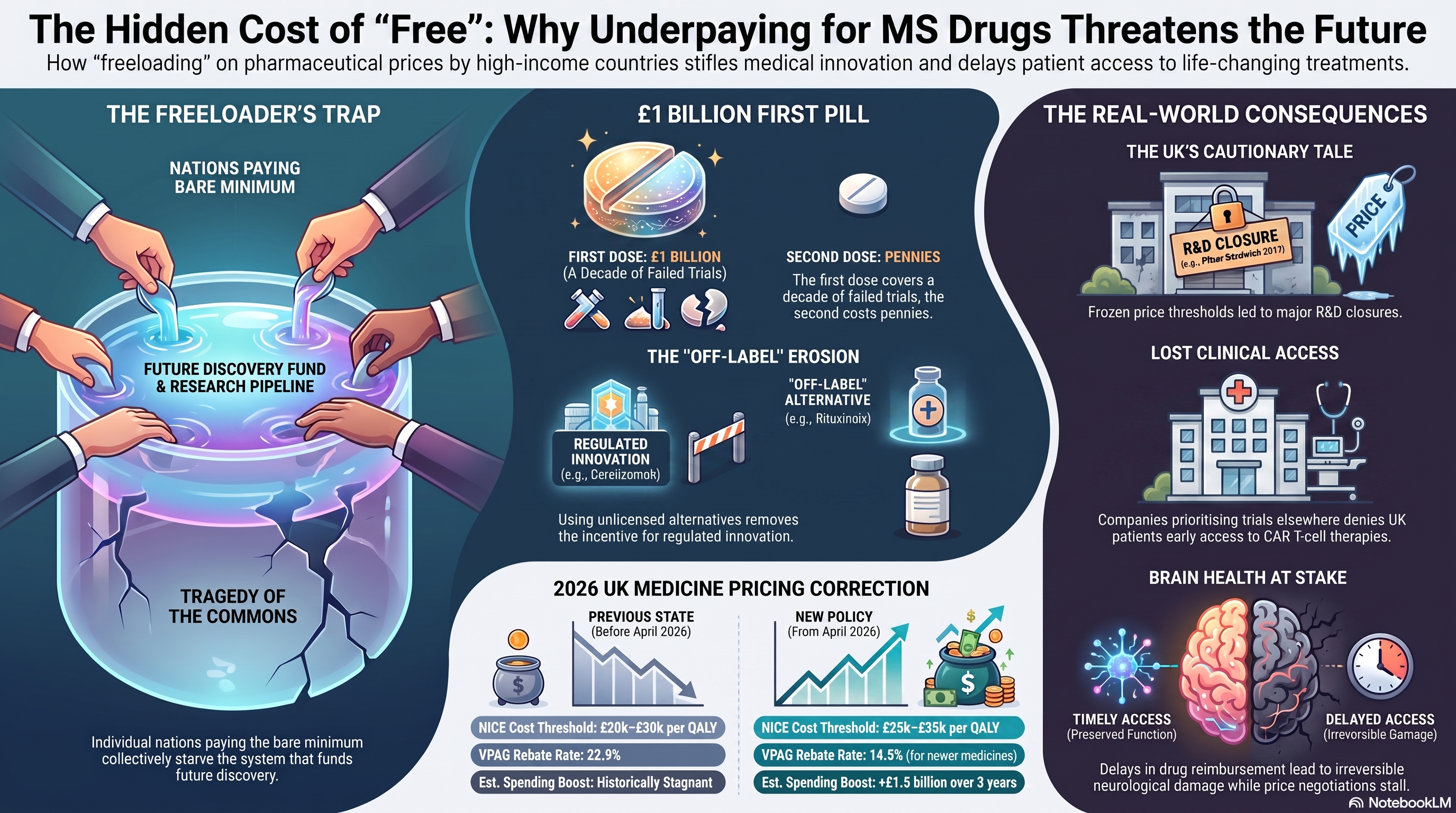
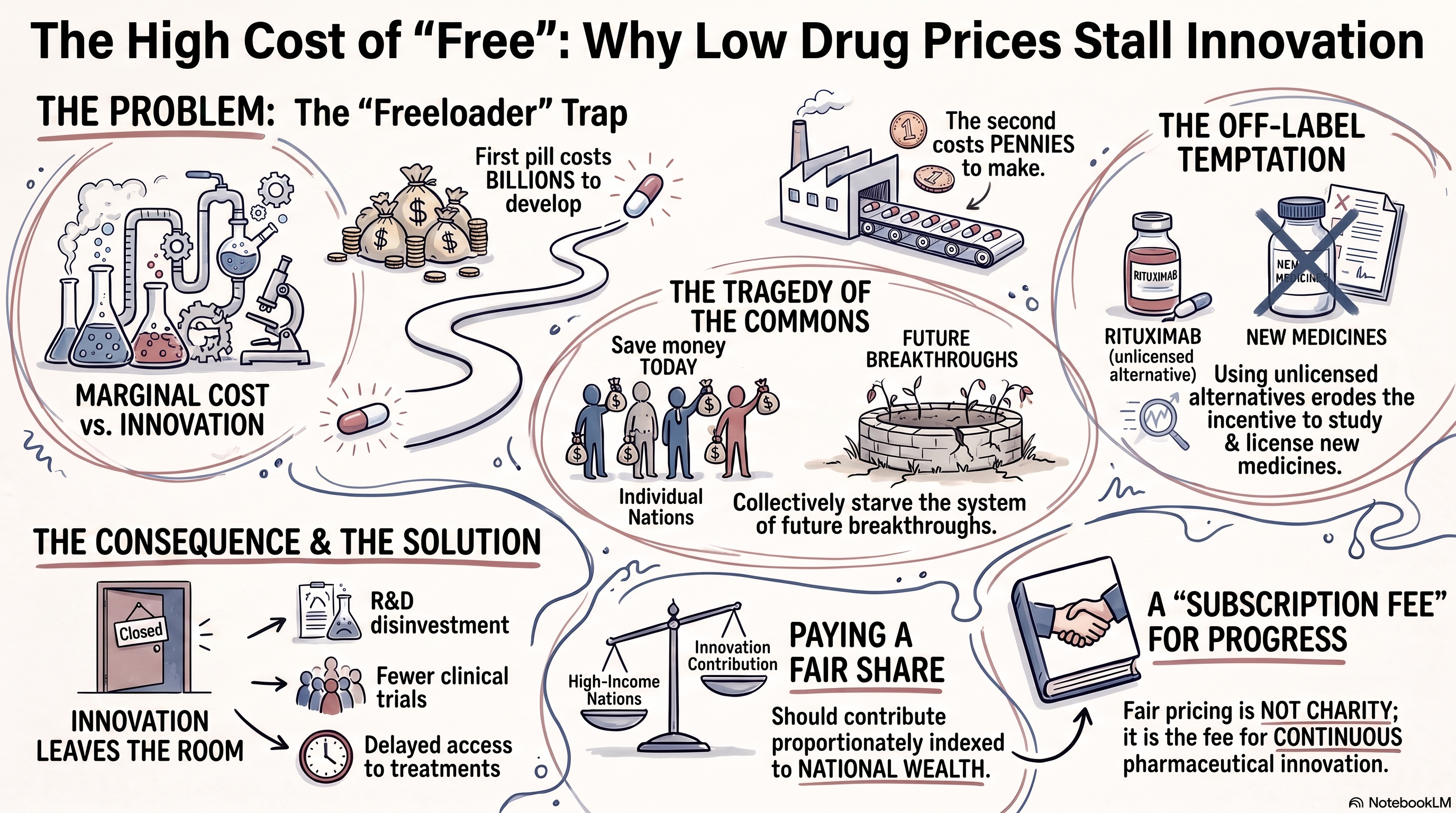
The economics of a new medicine are lopsided in a very particular way. The first pill costs a billion pounds or more to produce because it is embedded with failed molecules, abandoned programmes, a decade of trials, and the regulatory apparatus that sits behind it. The second pill costs pennies. Once a drug exists, its marginal cost of manufacture bears almost no relationship to the cost of bringing it into existence, i.e. as a licensed drug.
A single purchaser, a national health service, has enormous power to push the price down towards that marginal cost. And here is the seductive part: it can do so without any immediate visible harm. The drug already exists. The research is already done. Squeezing the price looks like pure gain for the health system and pure loss for a wealthy multinational that few constituents and voters will weep for.
The trap is that this only works if someone, somewhere, is still paying enough to fund the next cycle of discovery. A price close to marginal cost covers manufacturing costs; it does not cover innovation. If every high-income country negotiates as though the research were a sunk cost that has nothing to do with them, then the research stops being funded, not this year, not next year, but slowly, in the drying up of the pipeline a decade hence. It is a textbook case of the tragedy of the commons. Each buyer is individually rational to pay as little as possible. Collectively, we starve the very system that keeps producing the innovations we are haggling over.
The UK’s own cautionary tale
We have already run this experiment, and we should be honest about the results.
When NICE was established in 1999, and cost-effectiveness analysis became the gatekeeper for NHS access, the UK effectively announced to the world that it would pay for health gain up to a fixed threshold, i.e., £20,000-£30,000 per quality-adjusted life year, and not a penny more. That threshold then sat frozen for over two decades while everything around it inflated. In real terms, Britain was quietly paying less and less for innovation every year.
The consequences were not hypothetical. Companies read the signal and disinvested. Pfizer’s closure of its Sandwich research site in 2011, with the loss of nearly two thousand jobs, was the most visible casualty, but the broader retreat of pharmaceutical R&D from the UK was real and sustained. The UK told the industry we were a low-margin market that would extract maximum value at minimum price, and the industry, rationally, took its laboratories elsewhere. The jobs, the clinical trials, the early access to new molecules and the tax revenue followed them out the door. We saved money on the drugs bill and lost far more in the life-sciences economy we claimed to want to lead.
This is why the recent correction matters. Under Patrick Vallance, the government has finally moved. From April 2026, NICE’s cost-effectiveness threshold rises by 25% to £25,000–£35,000 per QALY, the first meaningful uplift since NICE was founded. Alongside it, the Voluntary Scheme for Branded Medicines Pricing (VPAG) rebate rate that companies pay back to the Treasury on branded-medicine sales is being cut sharply, from 22.9% in 2025 to 14.5% for newer medicines, and the whole package is bound up in a UK–US trade agreement that secures zero tariffs on British pharmaceutical exports. The Treasury estimates this will lift medicines spending by around £1.5 billion over three years; roughly from 0.3% to 0.35% of GDP.
You can read that as a capitulation to industry lobbying. I read it as an overdue admission that we had been freeloading, that the freeloading was costing us investment, and that a fair contribution is the price of staying at the innovation table.
The off-label temptation
The same logic plays out in a subtler and, I think, more troubling arena: the substitution of cheap, unlicensed alternatives for expensive licensed innovator drugs. For example, using rituximab instead of ocrelizumab.
The clearest example is bevacizumab. Roche’s Avastin is licensed as a cancer drug, but when compounded and used off-label, it is a highly effective treatment for wet age-related macular degeneration, at roughly £28 per injection, compared with £551 for Novartis’s Lucentis and £816 for Bayer’s Eylea. Twelve NHS commissioning groups adopted a policy of preferring the off-label drug; Novartis and Bayer took them to court, and the NHS won, all the way up through the Court of Appeal. On the ledger it looks like a triumph: savings running to hundreds of millions of pounds a year, redirected to other patients.
I understand the appeal, and as a clinician I do not pretend the licensed prices are reasonable. But look at what the manoeuvre actually does to the incentive structure. A company that invests in trials, licensing, and pharmacovigilance to bring a properly regulated ophthalmic drug to market finds itself undercut by a cheaper, unlicensed version of another product that incurred none of those costs. If that becomes the routine response to a high price, the message to industry is that developing and licensing a medicine for a new indication is a mug’s game; someone will simply compound their way around you. We get short-term savings and, again, quietly erode the systems and machinery that produce licensed, studied, and monitored medicines in the first place. It is freeloading dressed as clinical pragmatism.
Who actually pays
The freeloader likes to imagine the cost falls on the pharmaceutical companies. It does not, or not for long. It falls on the freeloader’s own future.
When a country establishes a reputation as a hard, low-price market, it goes to the back of the launch queue. New medicines arrive later, if at all; companies deprioritise regulatory filings and reimbursement negotiations in markets that will fight them on every pound. British patients wait longer than Americans, Germans or even some smaller European patients for drugs that already exist. In the field of multiple sclerosis, the gap between a therapy being available and it being reimbursed here has real neurological consequences; brains and spinal cords that could have been protected are instead being lost while we argue about thresholds. The opportunity cost of freeloading is not measured only in disinvestment and lost jobs. It is measured in the medicines that are never developed and the ones that arrive too late.
What a fair contribution looks like
None of this is an argument for a blank cheque. Pharmaceutical pricing is not a pure meritocracy of innovation. There is genuine rent-seeking, evergreening of patents, marketing budgets that dwarf research spend, pricing in some categories that is frankly indefensible, and paying CEOs obscene bonuses. I think a fair contribution is not the same as paying whatever is demanded, and value assessment of the kind NICE pioneered is the right tool for distinguishing genuine innovation from repackaged mediocrity, i.e., me-too medications with no real added value. The problem in the UK is that we never assessed value; we set the price of value too low and then froze it.
The principle I would hold is that every high-income country’s approach is simple: if you can afford to benefit from the innovation, you should contribute proportionately to funding it. A fair share indexed to national wealth and ability to pay, applied consistently across all rich nations, would spread the burden of R&D across the many shoulders that enjoy its fruits, rather than concentrating it on one market while the rest of us free-ride and congratulate ourselves on our negotiating skills. That is not charity to industry. It is the subscription fee for a service, continuous pharmaceutical innovation, that we all consume and that none of us wants to see collapse.
I am not sure whether pwMS are aware that AstraZeneca, a British pharmaceutical company, has decided not to recruit patients with MS in the UK for its new CD19-targeted CAR T-cell trial. This is an example of pwMS living in the UK being denied cutting-edge innovation by a British company. I am having similar responses from Pharmaceutical companies developing EBV vaccines to prevent infectious mononucleosis. They all intend to conduct their phase 1 and 2 trials in other countries. This is such a tragedy for British citizens.
The lunch was never free. The only question is whether we pay our share now at fair prices, or later, into a pipeline that runs dry. When a successful EBV vaccine to prevent IM is licensed, will the UK be included on the early adoption list? Based on the current political environment, I suspect not.
Finally, in parallel, to ensure that high-income countries pay their fair share of the innovation bill, we need to ensure that people with MS in low- and middle-income countries don’t lose out. This is why others and I have spent a lot of time fighting for pwMS in LMICs to have access to licensed DMTs at low-cost, or to allow them to be treated with off-label alternatives.
I am sure many of you will disagree with me. But the treatment of MS is part of a complex international network and relatively small decisions often reverberate around the world with consequences for pwMS and the next generation of pwMS who deserve access to the best treatments.
Please feel free to disagree with me. Agreeable disagreements are what the UK is about.
Accidental readers
If you have been forwarded this email and are not an MS-Selfie subscriber, please consider subscribing and helping MS-Selfie expand its resources for the broader MS community. MS-Selfie relies on subscriptions to fund its curated MS-Selfie microsite, MS-Selfie books, MS-Selfie Infocards, and other activities that extend beyond the MS-Selfie Substack newsletters.
Subscriptions and donations
MS-Selfie newsletters and access to the MS-Selfie microsite are free. In comparison, off-topic Q&A sessions are restricted to paying subscribers. Subscriptions are being used to run and maintain the MS-Selfie microsite and other related activities, as I don’t have time to do this myself. You must be a paying subscriber to ask questions unrelated to the newsletters or podcasts. If you can’t afford to become a paying subscriber, please email a request for a complimentary subscription (ms-selfie@giovannoni.net).
Questions
If you have questions unrelated to the newsletters or podcasts, please email them to ms-selfie@giovannoni.net. Prof. G will try to answer them as quickly as possible.
Important Links
🖋 Medium
General Disclaimer
Please note that the opinions expressed here are those of Professor Giovannoni and do not necessarily reflect the positions of Queen Mary University of London or Barts Health NHS Trust. The advice is intended as general and should not be interpreted as personal clinical advice. If you have any problems, please tell your healthcare professional, who can help you.
The whole system stinks.
“The global Multiple Sclerosis (MS) drugs market generates approximately $22.95 to $29.37 billion annually. This specialized space is heavily dominated by monoclonal antibodies, with Roche’s Ocrevus leading globally at about $7.6 billion in yearly sales.”
Top industry pay packages for recent fiscal years:
- Johnson & Johnson: Joaquin Duato leads the pack, with his compensation jumping to $32.8M.
- Novartis: Vasant (Vas) Narasimhan earns roughly $32M.
- Pfizer: Albert Bourla received $27.6M after overseeing recent strategic acquisitions.
- AstraZeneca: Pascal Soriot earned around $23.9M.
C.$30 billion a year revenues from MS therapies, yet not one tackles the real MS (smouldering MS), not one tackles the cause of MS (EBV), and not one reverses damage (remyelination therapy, therapies to promote axonal growth etc.).
I hope you can bring this desperately needed argument for discussion at government level.