

The Expanded Disability Status Scale (EDSS) does not capture the full impact of MS. Anyone who has ever cared for a person with advanced MS knows that many domains of neurological function important for keeping people with MS independent are missed by the EDSS. Do you agree?
Your EDSS can be stable, and you can still be getting worse. In short, the EDSS has multiple blind spots, one of which involves upper-limb and hand function.

Today marks the publication of the ORATORIO-HAND study in The Lancet, which challenges the EDSS’s supremacy as the primary outcome for assessing the effects of DMTs on progressive MS.
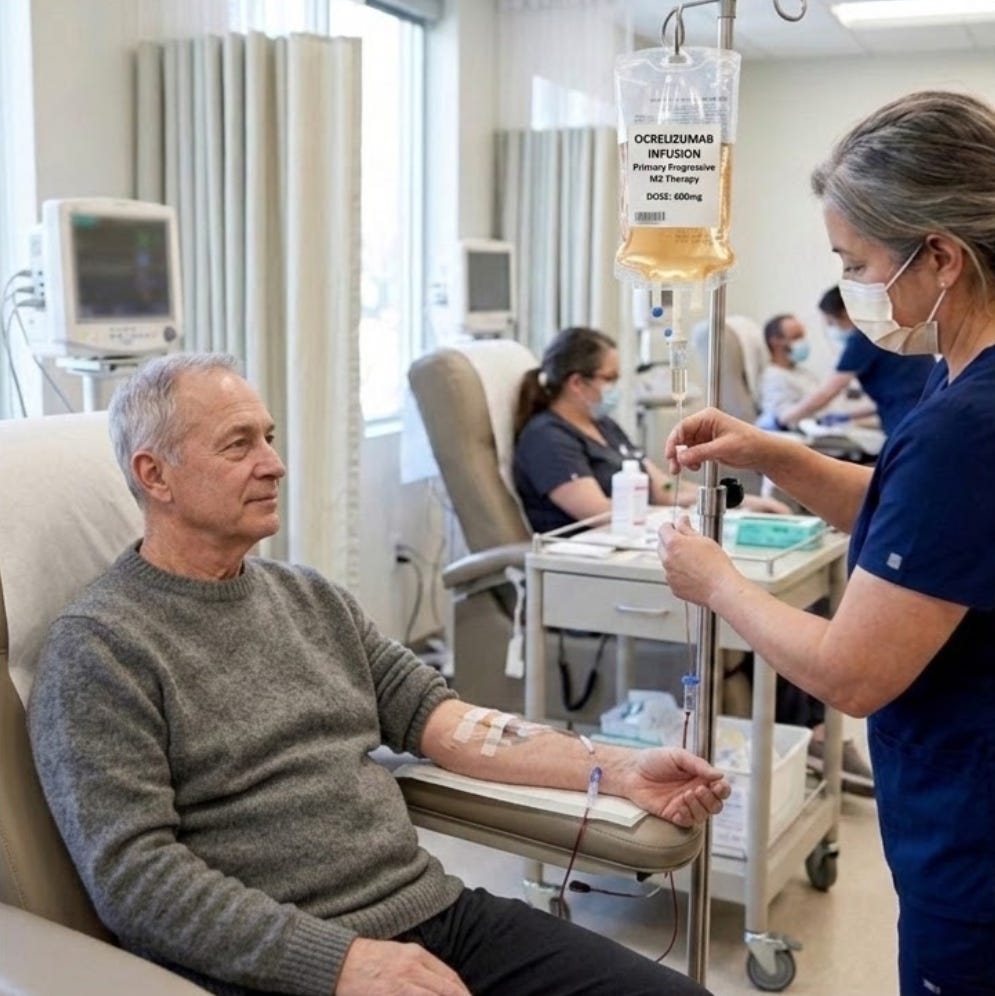
Summary of results
ORATORIO-HAND is a positive phase 3b trial of ocrelizumab in primary progressive MS (PPMS). In 1,013 pwMS randomised to ocrelizumab or placebo, ocrelizumab reduced the risk of 12-week composite confirmed disability progression (cCDP) on the EDSS or the nine-hole peg test (9HPT) by 30% (HR 0.70, 95% CI 0.57–0.86, p=0.0007). In pwMS with baseline MRI activity, the risk reduction was 55%.
Ocrelizumab treated subjects also showed a significant reduction in the risk of disability progression in each individual component with a 41% risk reduction (p=0·0002) in 12-week disability progression in 9HPT, corresponding to progression rates of 17% with ocrelizumab and 25% with placebo (Table 1); and 33% risk reduction (p=0·0013) in 12-week CDP in EDSS, corresponding to progression rates of 23% with ocrelizumab and 31% with placebo.
Among pwMS still ambulatory at baseline, the risk of requiring a wheelchair fell by 52%. All the results, including the relative and absolute risk reductions and the number needed to treat, are summarised in the paper and are not too bad at all. I suspect ocrelizumab will be a cost-effective treatment for pwPPM who are using a wheelchair. Don’t forget that once you lose your hand function, you lose your independence and need 24-hour-a-day care. Being EDSS 8.5 and above is very expensive.
Please note that the safety profile of ocrelizumab in ORATORIO-HAND was similar to that observed in other pivotal phase 3 studies and in a decade of post-marketing experience and surveillance.
Importantly, the ORATORIO-HAND study is not merely a confirmatory trial of the original phase 3 ORATORIO PPMS study. It is the first randomised, placebo-controlled evidence in MS that a disease-modifying therapy (DMT) can preserve hand function in people with advanced PPMS, i.e. in subjects aged up to 65 years of age, with an EDSS score between 6.5 and 8.0, who are wheelchair-dependent, using a composite endpoint of confirmed disability progression on either the EDSS or the 9HPT. This treatment effect in the more advanced subjects would have been missed if the EDSS alone had been used. Each of these findings overturns the MS orthodoxy that has, for too long, restricted who gets recruited into clinical trials and, subsequently, who gets treated, when, and on what evidence.
Background theory
We have proposed that progressive MS would be best understood as a length-dependent central axonopathy. The argument, drawing on a model originally hinted at by Kurtzke himself, is relatively straightforward. If MS lesions occur randomly throughout the central nervous system, then the neuronal pathways with the longest central axons will, on average, accumulate the most lesions. The corticospinal tract, which supplies the legs, is the longest pathway in the central nervous system. The corticospinal projections to the arms and hands are considerably shorter. Visual and brainstem pathways are shorter still. Based on this basic anatomy, two predictions followed from the length-dependent central axonopathy hypothesis. First, clinically apparent progression should emerge first in the legs, then later (or in some pwMS, never) in the arms, hands, and other systems with shorter axons. These predictions are what we see clinically: progressive MS typically declares itself as progressive weakness in the lower limbs, with hand involvement following years later. The second prediction that has driven much of the subsequent debate is that neuronal pathways with preserved functional reserve should remain more responsive to anti-inflammatory DMT, even when longer pathways have already exhausted their reserve and entered the apparently treatment-refractory progressive phase. We referred to this as the asynchronous progressive MS hypothesis, and it carries an important corollary: the therapeutic lag to measurable benefit will be shorter and more pronounced in neuronal systems supplied by shorter neuronal pathways. This was noted and ignored in many earlier studies, including the original phase 3 ORATORIO trial, where the treatment effect on hand function, as measured by the 9-HPT, was almost double that seen on predominantly lower-limb function with the EDSS.
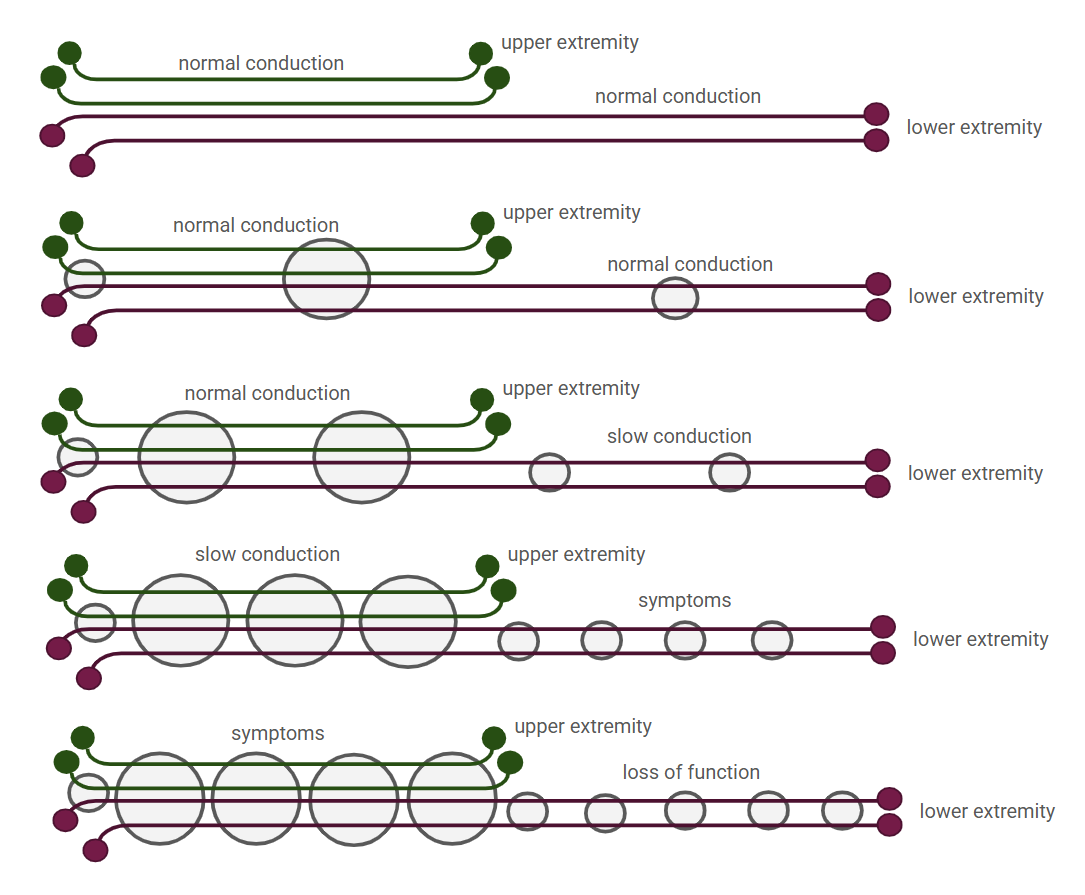
These observations underpinned the ORATORIO-HAND study, which used a population enriched for advanced PPMS: 16% of participants had baseline EDSS scores above 6.5, and 27% were aged over 55. Ocrelizumab produced its most striking effects on hand function. The 41% relative reduction in 9HPT progression exceeded the 33% reduction in EDSS progression. In the subgroup with EDSS scores above 6.5 (participants who were wheelchair-dependent and whose lower-limb corticospinal system had effectively exhausted its reserve), ocrelizumab still reduced 12-week cCDP by 49% and 9HPT progression by 41%. The treatment effect on patient-reported upper-limb function (the Neuro-QoL-UE) was significant: MRI-active pwMS improved on ocrelizumab, whereas placebo-treated pwMS deteriorated.
This observation of greater or preserved responsiveness in shorter neuronal pathways, even when longer pathways are no longer salvageable, is consistent with the length-dependent axonopathy hypothesis. The ORATORIO-HAND data support it as a working model for trial design and future clinical decision-making.
The people with MS behind O’HAND
When we discuss ORATORIO-HAND, it is important to acknowledge the patient community that helped make it possible. The #ThinkHand campaign, which we launched in 2016, has been well described on MS-Selfie. It began from an observation that trials of DMTs routinely excluded people with MS who used wheelchairs, on the assumption that nothing could be done for them; the so-called unsalvageables. The justification led to a circular argument. Because trials measured benefit predominantly through ambulation, and because wheelchair users could not walk, they were deemed ineligible. Because they were ineligible, no class 1 trial evidence was generated from wheelchair users. Without evidence of the effectiveness of DMTs in wheelchair users, the assumption that nothing could be done was perpetuated.
The ThinkHand campaign challenged this circular argument from multiple angles. The campaign’s surveys, conducted through The MS Research Blog, found that 92% of people with MS placed greater importance on their upper-limb function than their lower-limb function, and 95% felt that wheelchair users should not be excluded from DMT trials. In a contemporary survey, 75% of UK MS neurologists routinely stopped prescribing DMTs once pwMS needed a wheelchair, though 61% believed the drugs were probably still effective. The campaign developed a low-cost cardboard 9HPT distributed to 12,000 delegates at ECTRIMS, co-designed the Under & Over upper limb and hand rehabilitation tool with people living with advanced MS, and catalysed three clinical trials with upper-limb function as part of the primary endpoint: ChariotMS, which focuses specifically on wheelchair users, the ORATORIO-HAND study, which deliberately broke the EDSS 6.5 ceiling that had constrained the original ORATORIO trial and the OCTOPUS multi-arm platform study.
The decision in ORATORIO-HAND to enrol pwMS with EDSS scores up to 8.0, to use a composite primary endpoint anchored on the 9HPT, and to power the trial specifically to detect benefit in hand function did not simply emerge from the laboratory, animal house, clinic, sponsor, or regulators. It emerged from people with MS telling us, loudly, repeatedly, and with the moral authority of lived experience, that we had been measuring the wrong thing. ORATORIO-HAND is, in a very real sense, their trial. The 41% reduction in the risk of worsening hand function, as measured by the 9HPT, is their victory. The sponsor, regulators, healthcare systems, payers, and HCPs now need to deliver on the ORATORIO-HAND results and ensure that people with advanced PPMS can receive ocrelizumab.
Label change
ORATORIO-HAND should prompt a formal revision of the ocrelizumab prescribing label. The current European and US labels for PPMS reflect the eligibility criteria of the original ORATORIO trial, which enrolled pwMS aged 18–55 years with EDSS scores of 3.0–6.5. The current label is based on data from 2017. ORATORIO-HAND has now demonstrated efficacy in pwMS aged up to 65 and with EDSS scores up to 8.0, and on the clinically relevant endpoint of hand function. Importantly, the safety profile, despite an older and more disabled population, was consistent with the drug’s established profile, with no new signals once the impact of the COVID-19 pandemic on respiratory infections is accounted for.
Three specific label revisions for ocrelizumab are needed. First, the upper age limit should be raised, or, more appropriately, removed, given that the data do not support a sudden biological change at 55. In addition, observational cohorts have shown continued benefit from ocrelizumab treatment beyond this age. Second, the EDSS ceiling should be raised from 6.5 to 8.0 to reflect the population in which efficacy has now been demonstrated. Third, the indication should explicitly include preservation of upper-limb function as a treatment goal, recognising the 9HPT as a validated outcome and aligning the label with what pwMS consider clinically meaningful. Without these changes, the ocrelizumab label will continue to function as a barrier, preventing reimbursement, restricting prescribing, and denying treatment to pwMS for whom we now have strong evidence of benefit.
The question I have for Roche is, would it be ethical not to push for a label change, given the results and the sacrifices pwMS have made to participate in this trial? They may never forgive you if you didn’t.
Stopping criteria
The implications of ORATORIO-HAND extend beyond the regulatory label to the local commissioning policies and stopping rules that govern day-to-day prescribing. In England, for example, the NHS England commissioning policy for DMTs in MS requires discontinuation of treatment when a patient reaches an EDSS score of 7.0 or becomes wheelchair-dependent. Similar stopping rules operate, formally or informally, in many other healthcare systems. These rules were never grounded in evidence but rather in a lack thereof. ORATORIO-HAND replaces this absence with data.
I predict it will be an uphill battle to get NHS England to change its stopping criteria for ocrelizumab. Any ideas on how we can make this happen?
What about SPMS?
The lessons of ORATORIO-HAND do not stop at PPMS. The asynchronous progressive MS hypothesis predicts that the same length-dependent logic should apply to secondary progressive MS, in which many pwMS still retain useful upper-limb function long after walking is lost. The ongoing investigator-led trials, such as ChariotMS, will test whether this prediction holds. If it does, and the biology gives every reason to expect that it will, then the entire stopping-rule architecture for DMTs in MS will need to be rebuilt around upper-limb function rather than ambulation.
There is also a broader methodological point. ORATORIO-HAND is the first MS trial designed from the outset to take upper-limb function seriously, and it succeeded where its predecessors, particularly in more advanced populations, had failed. The lesson for trialists is clear: in progressive MS, an endpoint that does not include the 9HPT, on the available evidence, asks the wrong question.
ORATORIO-HAND is, in the end, a study about listening. It is about listening to pwMS who told us that their hand function mattered more than ambulation. It is about listening to the data that told us that wheelchair users were being denied therapies that might still help them. It is about listening to a hypothesis, that progressive MS is a length-dependent central axonopathy, which predicted, ahead of the evidence, what a trial like this would find. The work now is to act on what we have heard, to rewrite the ocrelizumab label, to revise the starting and stopping criteria, and to design the next generation of trials around the functional domain that pwMS have been telling us matters most for years.
Thank you
I would like to thank Roche for believing in the science and agreeing to fund the extension of this study into wheelchair users. Other Pharma companies would have said no. I am aware that several staff members at Roche went above and beyond their duties to secure funding for this study. I won’t forget who you are; you are now part of MS history. Don’t forget the unsalvageable are now salvageable.
I would like to thank the pwMS for participating in this study at a time when ocrelizumab was already licensed for treating active PPMS. If it wasn’t for your altruism, the next generation of pwPPMS with more advanced disability may have remained unsalvageable. Thank you, thank you, thank you,....
Then to all the sites across the world for helping make this trial a success, and to my colleagues on the steering committee. To the best of my knowledge, this was the first steering committee in which we sought to advance gender equality; possibly another milestone for the field of MS.
I assume a lot of what is discussed in this newsletter may be too scientific. Don’t be shy and ask questions.
Paper
Background: The ORATORIO trial showed that ocrelizumab reduced the risk of disability progression versus placebo in patients with primary progressive multiple sclerosis (PPMS). We aimed to elucidate the effect of ocrelizumab in older and more disabled patients with PPMS, particularly with respect to hand function preservation.
Methods: ORATORIO-HAND was a multicentre, double-blind, randomised, placebo-controlled, phase 3b study with 138 sites across 22 countries. Patients with PPMS aged 18–65 years and Expanded Disability Status Scale (EDSS) score of 3·0–8·0 were randomly assigned 1:1 to intravenous ocrelizumab 600 mg or placebo every 6 months for 144 weeks or until a prespecified number of progression events occurred. Masking was achieved by use of a placebo solution administered in the same manner as ocrelizumab. Double-blinding across all periods was maintained through separation of investigators responsible for efficacy and safety assessments. MRI scans were evaluated by a masked central reader, and laboratory parameters that could reveal treatment allocation were masked to site personnel until the primary analysis. Two coprimary estimands were defined, with the endpoint of time to onset of 12-week composite confirmed disability progression (12W-cCDP) in 9-Hole Peg Test or EDSS evaluated in all randomly assigned patients, and the same endpoint evaluated in a subset of patients with MRI activity at baseline. This study is registered with ClinicalTrials.gov, NCT04035005 and is ongoing and not recruiting.
Findings: Between Aug 12, 2019, and Dec 10, 2024, of 1360 patients assessed for eligibility, 1013 were randomly assigned (ocrelizumab [n=505]; placebo [n=508]). The proportion of patients with 12W-cCDP was 165 (33%) of 505 with ocrelizumab and 205 (40%) of 508 with placebo (hazard ratio, 95% CI 0·70 0·57–0·86; relative risk reduction=30%; p=0·0007). In the MRI-active subgroup, a significant risk reduction was also observed in 12W-cCDP (risk reduction=55%; p<0·0001). The overall safety profile was similar in both groups. More infections (245 [48%] of 506 vs 226 [45%] of 506) were observed with ocrelizumab, but not after COVID-19 was excluded (38% vs 37%). Rates of serious adverse events and serious infections were similar between groups.
Interpretation: Ocrelizumab was superior to placebo in delaying disability progression, with stronger effect on hand function, in a broad PPMS population including older patients and those with more advanced disease, while maintaining a manageable safety profile.
Funding: F Hoffmann-La Roche.
Accidental readers
If you have been forwarded this email and are not an MS-Selfie subscriber, please consider subscribing and helping MS-Selfie expand its resources for the broader MS community. MS-Selfie relies on subscriptions to fund its curated MS-Selfie microsite, MS-Selfie books, MS-Selfie Infocards, and other activities that extend beyond the MS-Selfie Substack newsletters.
Subscriptions and donations
MS-Selfie newsletters and access to the MS-Selfie microsite are free. In comparison, off-topic Q&A sessions are restricted to paying subscribers. Subscriptions are being used to run and maintain the MS Selfie microsite and other related activities, as I don’t have time to do this myself. You must be a paying subscriber to ask questions unrelated to the newsletters or podcasts. If you can’t afford to become a paying subscriber, please email a request for a complimentary subscription (ms-selfie@giovannoni.net).
Questions
If you have questions unrelated to the newsletters or podcasts, please email them to ms-selfie@giovannoni.net. Prof. G will try to answer them as quickly as possible.
Important Links
🖋 Medium
General Disclaimer
Please note that the opinions expressed here are those of Professor Giovannoni and do not necessarily reflect the positions of Queen Mary University of London or Barts Health NHS Trust. The advice is intended as general and should not be interpreted as personal clinical advice. If you have any problems, please tell your healthcare professional, who can help you.
OK, I might have cried reading this, there finally seems to be progress for people like me!
I was relabelled SPMS in 2018 but hindsight suggests I have been PPMS all along. Neuros have never been concerned with the changes to my leg function, always telling me a I should be grateful my MRI is stable. Grateful I had become housebound? Grateful I couldn't function for my kids?
I started to see a private physio who convinced me to think of it more as an incomplete spinal injury because everything else works as normal - hands, cognition etc. My EDSS is at least 7 suggesting I'm ready for the scrapheap. In reality, I'm now a fully independent wheelchair user back to working full time, exercising daily and caring for my family.
I'd be perfectly happy if my condition could be stabilised at this point which is why I was so happy to read this!
Can I ask when you think this may become available on the NHS? And thank you for everything you continue to do for our community😊
It takes a village and you are certainly the loudest in our village. Always forward thinking and taking into account those that are living with MS. Congratulations on this amazing accomplishment.