

You may have noticed that I have been offline for a few days. I was in South Africa to attend my younger sister’s funeral, to celebrate her life and to spend time with my family.
My sister’s death was not unexpected. Twelve years ago, she was diagnosed with a chronic progressive interstitial lung disease. She presented with a 2-3 year prodrome of exertional shortness of breath and a dry cough. Her condition gradually deteriorated, and eventually she presented with respiratory failure. Once diagnosed, she required 24-hour-a-day oxygen therapy and immunosuppression. Her condition gradually worsened over the next 12 years.
With lung disease, you can measure the loss of end-organ function with various objective static and stress respiratory function tests. The latter includes exercise, for example, the two and six-minute walking tests. In the end, the only therapeutic option my sister had was a double-lung and heart transplant. Unfortunately, in South Africa, lung-heart transplants are only done in the private sector and for those with platinum or top-tier health insurance. Sadly, she was unemployed and didn’t have that option available to her. This makes me realise how fortunate I am to have the NHS as my healthcare system.
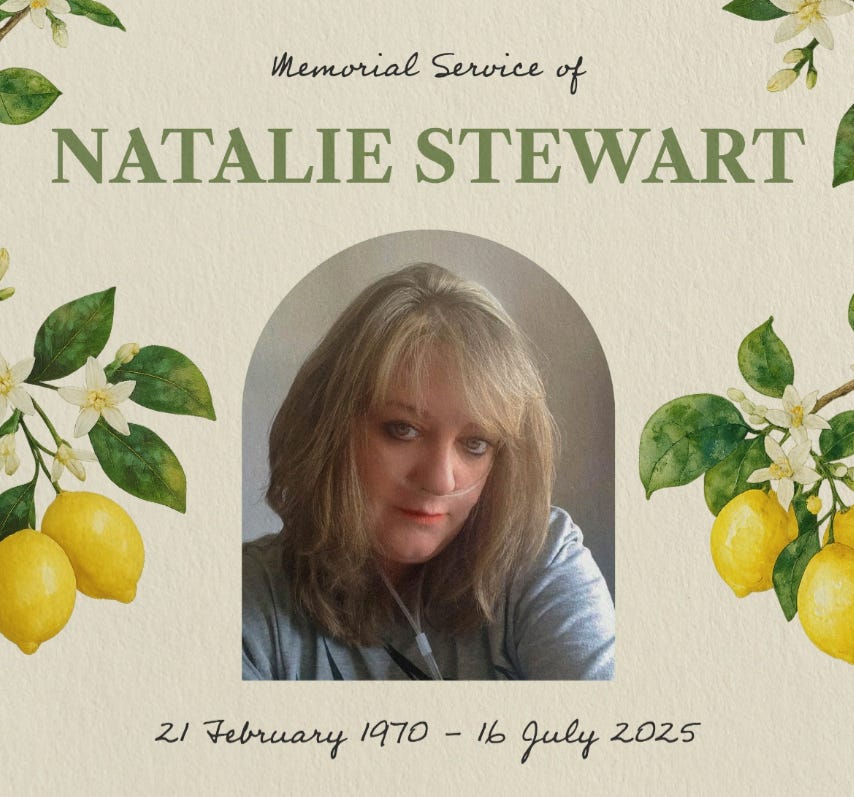
My sister did not have a pleasant death. Dying from respiratory failure with hypoxia is a very frightening experience. I am so grateful that I got the opportunity to see her in early May this year. When I last saw her, she was still able to speak for 20-30 seconds at a time, before she had to pause to allow her blood oxygen saturation to return to baseline. After that visit, I decided to write an essay on consciousness using hypoxia (lack of oxygen) and my sister as the narrative. I have submitted this essay to a writing competition. Once the competition is over, I will put it online for you to read.
This current visit to South Africa made me realise that if you have a chronic life-threatening condition that has a terminal phase, planning can significantly ease the burden on your family after you are gone. View this as a difficult, but loving, act that provides your next-of-kin with clarity and peace of mind during their time of grief. In general, MS is rarely a life-threatening disease. But as in life, MS has a terminal phase. Here are some things to consider when planning for your death:
1. Legal and financial planning:
Will or Trust: This is fundamental. A will dictates how your assets (property, money, and possessions) are to be distributed. A trust can be a more complex but effective way to manage and transfer assets. Without a will, the law will determine how your estate is handled, which may not align with your wishes.
Power of Attorney: Appoint a trusted person to make financial and legal decisions on your behalf if you become unable to do so. This can be a separate document for financial matters and a separate document for healthcare.
Life Insurance: Ensure your beneficiaries are up-to-date. The payout can help cover funeral costs, outstanding debts, and provide financial stability for your family.
Organise Financial Documents: Gather and organise all essential documents, including bank account information, investment statements, deeds, titles, and insurance policies. Create a list of all your assets and liabilities. My wife and I refer to this as the death box.
End-of-Life Care Wishes: A living will or advance directive outlines your preferences for medical treatment in the event you can't communicate them yourself. This can relieve your family from making difficult decisions about your care.
2. Funeral and End-of-Life Arrangements:
Pre-planning: Decide on your wishes for your funeral or memorial service. This includes whether you prefer burial or cremation, the location of the service, and any specific readings, music, or speakers. Pre-paying for these services can also remove a significant financial and emotional stressor for your family.
Write down your wishes: Document your preferences. Create lists so that your possessions are disposed of or given to the people you intend them to go to. You may want to leave a legacy to a charity. You need to act on this now. This allows your family to honour your wishes without having to guess what you would have wanted.
Obituary Information: Consider writing down some key details for your obituary, such as important milestones, loved ones to mention, and a favourite photo.
Organ Donation: Consider organ or body donation for research purposes.
3. Digital Legacy:
Create a list of all online accounts: In the modern era, this includes social media, email, banking, and subscription services.
Document usernames and passwords: Store this information in a secure place and let a trusted family member know where to find it. This prevents your family from having to deal with the frustrating process of trying to access and close accounts.
Digital Executor: Appoint someone to manage your digital assets and accounts after you're gone. Many online services now have specific protocols for this.
4. Personal Matters:
Create a "Memories" file: Write letters, record videos, or create a photo album for your loved ones. These personal messages can be incredibly comforting and a lasting legacy.
Share your stories: Talk to your family about your life, your values, and your hopes for them. This can be a profound way to connect and create lasting memories.
Prepare a list of people to be notified: This will help your family quickly and easily inform friends and family of your passing.
5. Seeking Professional Help:
Law Attorney: Appoint a lawyer or attorney who specialises in estate planning, wills, and trusts.
Financial Advisor: They can help you organise your finances, update beneficiaries, and plan for the future.
Therapist or Counsellor: Talking about your feelings and fears can be a great way to cope with the terminal phase of your disease. It can also help you prepare for these difficult conversations with your family.
While it is a difficult process, taking these steps can provide immense comfort to your loved ones. It is a final act of love that ensures your family can focus on grieving and remembering you, rather than being overwhelmed by legal and financial complexities.
Have I missed something off the list?
Subscriptions and donations
MS-Selfie newsletters and access to the MS-Selfie microsite are free. In comparison, weekly off-topic Q&A sessions are restricted to paying subscribers. Subscriptions are being used to run and maintain the MS Selfie microsite, as I don’t have time to do it myself. You must be a paying subscriber to ask questions unrelated to the Newsletters or Podcasts. If you can’t afford to become a paying subscriber, please email a request for a complimentary subscription (ms-selfie@giovannoni.net).
Important Links
🖋 Medium
General Disclaimer
Please note that the opinions expressed here are those of Professor Giovannoni and do not necessarily reflect the positions of Queen Mary University of London or Barts Health NHS Trust. The advice is intended as general and should not be interpreted as personal clinical advice. If you have problems, please tell your healthcare professional, who will be able to help you.
Having had the awful job of clearing a house following the death of a close family member, I made my mind up that I would spare my descendants as far as possible. Going through your own belongings and regularly de-cluttering is one big thankless task - but it's ten times worse if you leave it to someone else. I'll never forget pulling out drawers crammed with old clothes, days spent sorting papers, files, old bills etc., finding stuff you didn't know what to do with.. it was never-ending and deeply depressing.
Your news is very sad. As a medic you must realise there is another layer of vulnerability for you within your griefing process. I suspect there will be a tendency to medicalise your loss. Let the sadness in, it is necessary for the healing process to begin. Losing a sibling is a very unique grief. We expect to see our parents pass first but siblings before they’ve lived their expected years, is somehow different. Siblings share so much in the formatives year, it’s family secrets, similarities, early memories etc. I speak from the heart because I was not prepared for my sister’s death 4 years ago. It was her death that has spurred me to address many of the issues you have shared. Your sister will always be in your heart.